

Move freight forward with confidence
Your team already knows how to run a reliable operation. IntelliTrans gives them the clarity, tools, and support to do it with greater confidence and control.












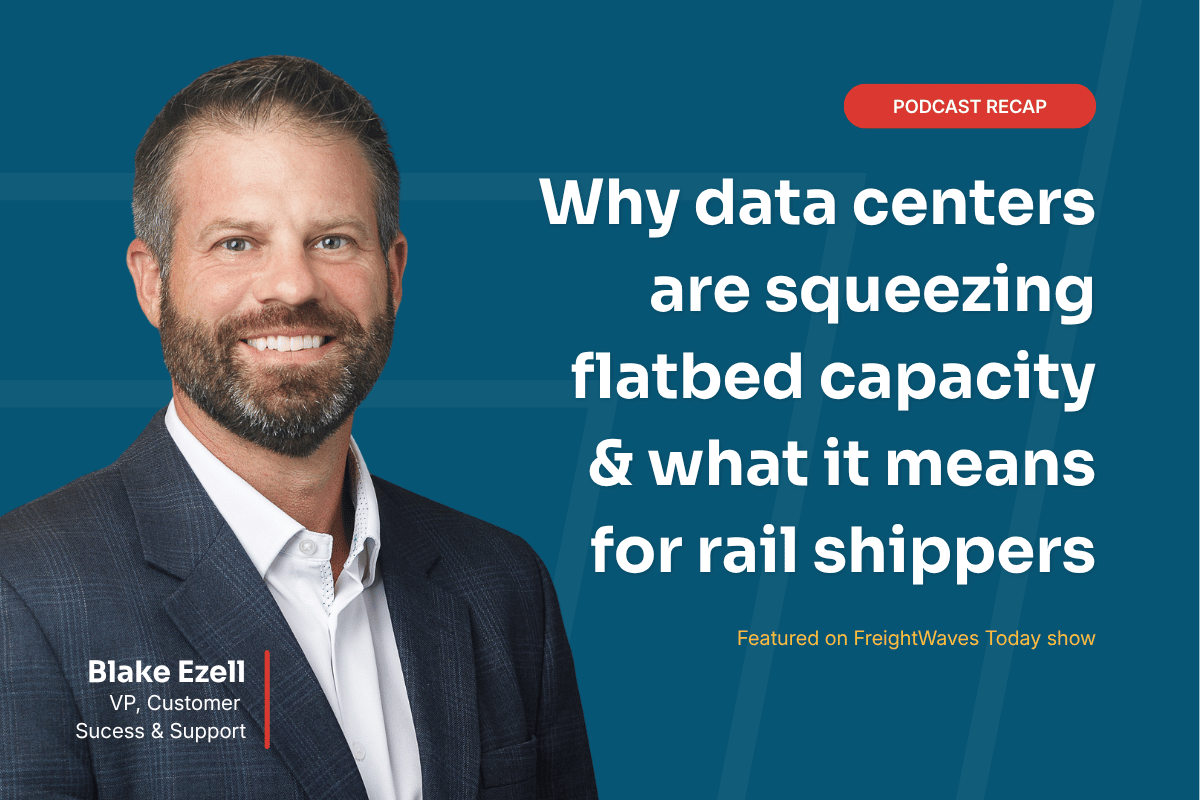

Freight rates are up in 2026 even though volumes are down. That is not a normal market signal, and according to Blake Ezell, VP of Customer Success and Support at IntelliTrans, it is not a normal market. In a recent conversation on FreightWaves Today, Ezell described what he calls a capacity tax: shippers paying premium rates not because demand is strong, but because supply is being pulled away from traditional freight lanes entirely. For bulk and break-bulk shippers watching flatbed rates climb while their own volumes stay flat, understanding where that capacity is going, and where it is not going, is the difference between reacting to the market and planning around it.
Most freight indices tell a simple story: tight capacity plus strong demand equals high rates. Ezell argues that story does not hold up in 2026. Bulk and break-bulk volumes have softened by roughly 4 percent since 2023, tender rejections are running near 16 percent, and flatbed capacity is running at a load-to-truck ratio Ezell put at 73 to 1. Rates are elevated anyway, in some cases still sitting near 2021 levels.
The reason is not more freight. It is fewer trucks available to move the freight that exists. Ezell pointed to driver attrition as a factor: the industry has lost close to 250,000 drivers since 2020, a mix of retirements and independent carriers exiting the business as fuel surcharge economics have squeezed their margins. Fewer available trucks, even in a softer demand environment, is enough to keep rates high.
The piece that makes this market different, in Ezell's view, is where that shrinking pool of flatbed and specialized capacity is being absorbed. It is not going to other commodity shippers. It is going to AI data center construction.
Ezell put a number on it during the conversation: estimates place the current data center freight market at roughly $83 billion, projected to reach $150 billion within five years.
Craig Fuller, Founder and CEO of FreightWaves and SONAR, put the scale in blunter terms during the same conversation: hyperscalers are spending on data center buildout at a pace comparable to $700 billion every two weeks, compared to the U.S. interstate highway system's roughly $20 billion a year over 35 years. He added that a single 500-megawatt data center requires an estimated 30,000 truckloads to build, and that a proposed 10-gigawatt facility in Utah would be twenty times that scale. Most of that freight, he noted, moves by flatbed: concrete, steel, PVC pipe, generators, transmission equipment, copper, and fiber optic cable.
The result is a bidding war that traditional commodity shippers were never built to win. Data center developers are effectively price insensitive. A 10 percent rate increase does not change their build timeline the way it would for a chemicals or building products shipper working on established margins.
This is the part of the conversation that matters most for bulk shippers, and it is where Ezell's argument sharpens into something actionable. While flatbed capacity is being pulled toward data centers, rail has not seen the same squeeze. Ezell put rail capacity utilization at around 70 percent, with rail rates up only about 2 percent, a fraction of the pressure showing up in the truck market.
Ezell describes that gap as a modal arbitrage opportunity: the practical savings available to a shipper willing to move freight currently on truck onto rail, typically through transload, where it makes sense by lane. It will not work for every shipment or every lane. But for shippers who have not recently re-evaluated where rail could absorb volume that is currently competing for scarce flatbed capacity, this is a window worth examining now rather than after rates climb further.
Ezell laid out a practical set of moves for shippers navigating this market:
Ezell's closing point tied all four together: in a market this tight, the advantage goes to shippers who understand their own data well enough to act on it quickly. As he put it, "it's the race to the underlying data... and it's not the race to the AI algorithm."
AI data center construction is not a short-term anomaly. Even conservative estimates suggest current data center announcements are years away from full build-out, which means the capacity pressure on flatbed freight is likely to persist rather than ease. For bulk and break-bulk shippers, the practical response is not to wait for the truck market to loosen. Instead, look for where rail can absorb volume today, at a fraction of the rate pressure, and have the lane-level visibility to act quickly.
IntelliTrans has spent more than 30 years managing rail freight for bulk and break-bulk shippers, including 38 percent of North American bulk rail freight managed today. That depth is part of why Ezell's read on this market carries weight: the capacity conversation is not theoretical for IntelliTrans customers; it is the daily work of moving freight through a rail network that still has room when truck does not.