
Move freight forward with confidence
Your team already knows how to run a reliable operation. IntelliTrans gives them the clarity, tools, and support to do it with greater confidence and control.












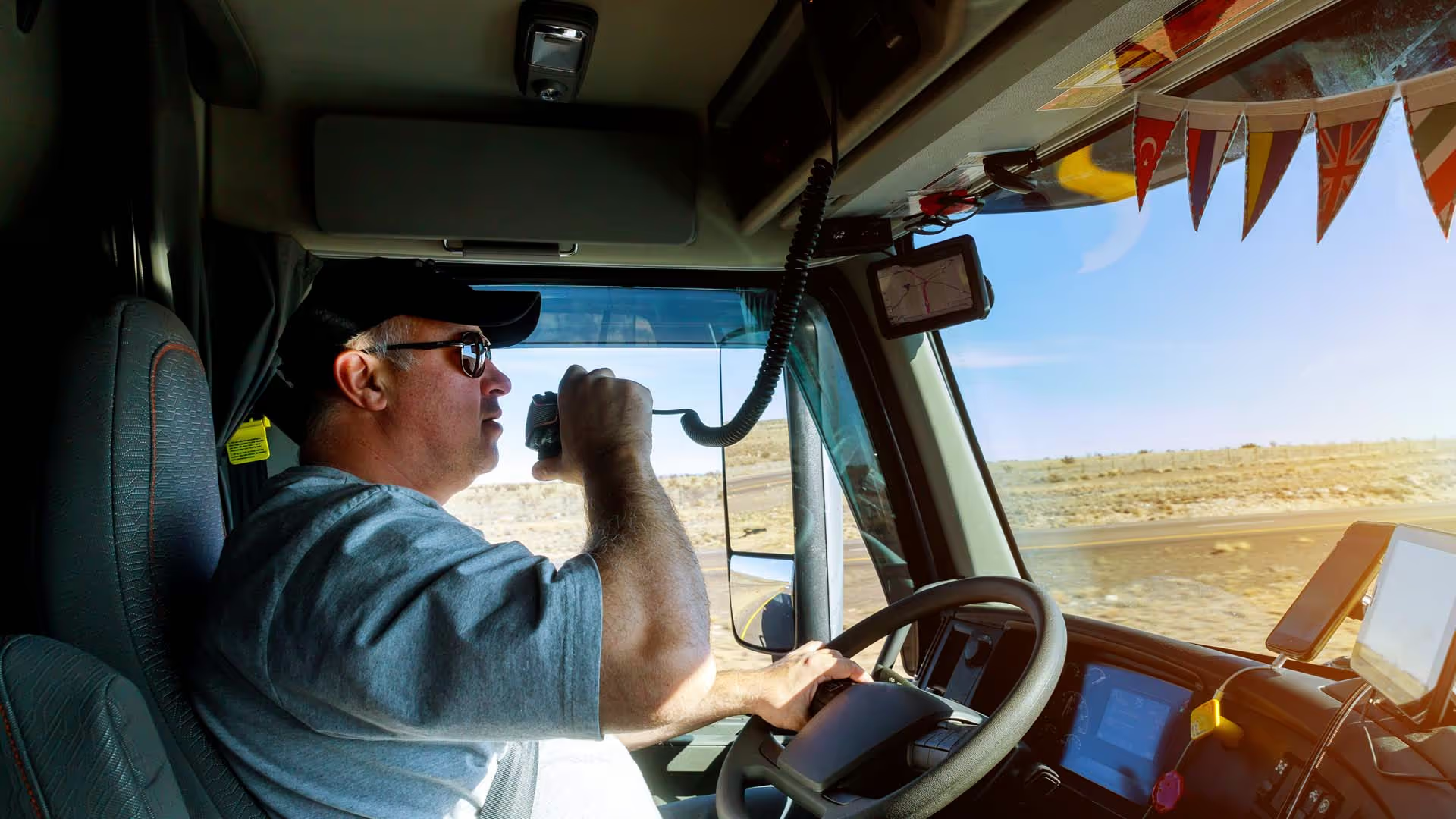

The nation's truck driver shortage predates the global pandemic, which only pushed it to full crisis level as demand for capacity soared, an overall labor shortage ensued, and a slew of drivers retired. Now, as the trucking sector works to right the ship, companies across all industries are feeling the pinch.
"Trucking has emerged as one of the most acute bottlenecks in a supply chain that has all but unraveled amid the pandemic," Transport Topics reports, "worsening supply shortages across industries, further fanning inflation and threatening a broader economic recovery."
In July, legislators and the Federal Motor Carrier Safety Administration (FMCSA) held a roundtable with the trucking industry to discuss driver retention and turnover. Key proposals included lowering the minimum interstate driving age from 21 to 18, and adding trucking to industries that can bypass certain Department of Labor immigration certification processes.
The federal infrastructure bill also included the DRIVE-Safe Act, targeting one of the biggest barriers to younger drivers entering the industry. "Once you are 18 years old, you can drive a semi from Rockford to Cairo. You can drive it anywhere inside a state, but what you can't do is drive across a state line," a representative from the Illinois Trucking Association told the Marietta Daily Journal. Under the new legislation, once a driver earns a CDL, they complete a two-step training program requiring at least 400 hours of on-duty time and 240 hours of driving time alongside an experienced driver.
By weight and value, trucks carry more freight than any other mode combined, according to the Bureau of Transportation Statistics (BTS), which estimates there are currently 1.8 million heavy and tractor-trailer truck drivers operating in the U.S. In 2019, the industry was already short nearly 61,000 drivers, according to the American Trucking Associations, which anticipates that number growing to 160,000 by 2028.
Factor in expected retirements and growing freight demand, and the ATA estimates the industry will need to hire roughly 1.1 million new drivers over the next decade, the Free-Lance Star reports. "That's an average of nearly 110,000 per year."
Shippers are feeling it now. "The truck driver situation is keeping me up at night; the situation continues to deteriorate," says the logistics director for one large timberland company. "I know that we lost a lot of drivers during COVID and we haven't been able to get them back into the industry." That company is now working more closely with its carriers and more carefully evaluating lane, mode, and provider choices to manage the gap.
While more drivers get trained and on the road, technology is helping shippers cope today. IntelliTrans' ever-expansive tendering system allows companies to present available shipments to a broader audience of carriers simultaneously.
Here's how it works: a TMS tendering algorithm provides load visibility to an expanding set of carriers in a structured, defined order to optimize both coverage and cost. Lower-cost carriers can still accept a load even when a higher-cost carrier already has visibility to it.
"This also allows more carriers to see your freight when loads are difficult to cover," says Ken Sherman, President at IntelliTrans.
This approach delivers real savings. IntelliTrans reports that the average cost of carriers that accepted a load was $110 lower than the highest-cost carrier currently viewing it.
"Instead of a carrier being able to view the load for 15 minutes before it's yanked and given to the next carrier, the shipper can leave the opportunity open for hours," Sherman explains. "This helps with load coverage in tight markets, where drivers are difficult to find, and it gets shippers to lower rates in looser markets."
Shippers can use this challenging time to invest in the technology they need to resolve immediate issues while also planning ahead. Even when driver availability returns to some level of normalcy, another disruption is likely waiting around the next corner.
"This is a great time to start securing some internal investment to try out new solutions like ever-expansive tendering algorithms," says Blake Ezell, Director, Supply Chain Consulting at IntelliTrans. "If you start planning for tomorrow today, you won't have to keep reacting to the market and putting out fires. Instead, you'll be putting together solutions in advance of the next potential roadblock."